TAT in Banking: Meaning and Complete Guide

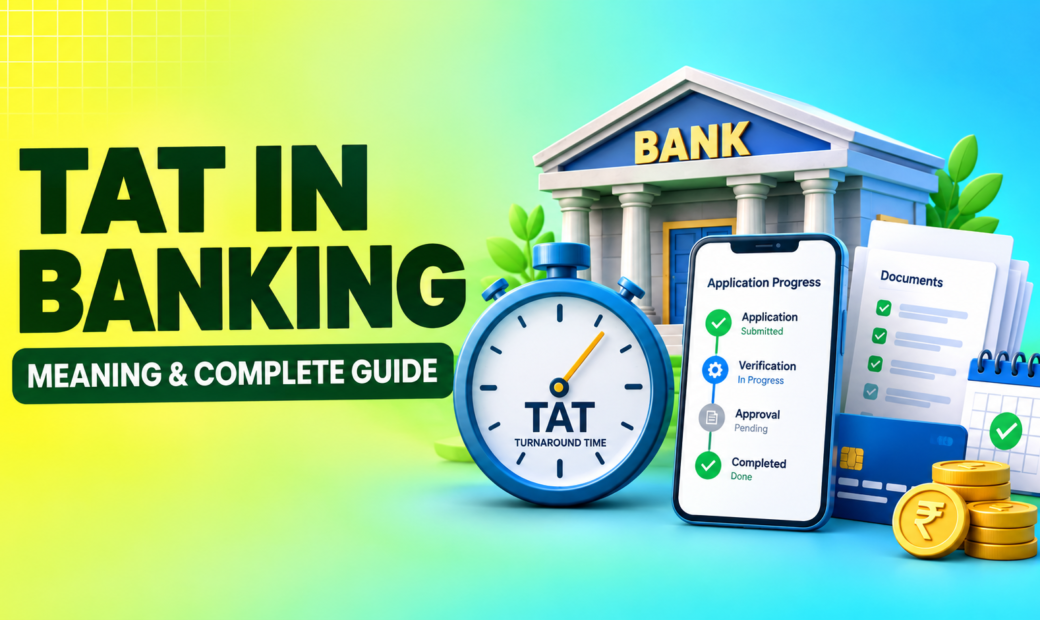
When you apply for a loan, open a bank account, submit a KYC request, or raise a service request, you may hear the term TAT. Banks and financial institutions use this term to explain how much time a particular process may take.
TAT stands for Turnaround Time. In simple words, it is the time required to complete a banking service or process from its starting point to its final outcome.
For customers, knowing the meaning of TAT can make banking processes easier to understand. It can also help you know when to expect an update and when it may be appropriate to contact the bank about a delay.
What is the full form of TAT in banking?
The full form of TAT is Turnaround Time.
In banking, TAT refers to the time taken by a bank or financial institution to complete a particular service, request, application, or transaction. The starting point and ending point can differ depending on the service.
For example, a bank may mention a specific processing period for a personal loan application. The TAT may start after the bank receives the required documents and may end when the application receives a final decision.
TAT can be measured in hours, working days, or calendar days. Customers should check the terms provided by the bank because different services can have different methods of calculating the timeline.
What does TAT mean in banking?
TAT basically tells you how long a banking process is expected to take.
Suppose you submit a request to update your KYC details. The bank may need to check your documents, verify the information, update its records, and confirm the request. The time taken for these steps forms part of the TAT for that service.
TAT is used for many banking activities, including:
- Loan application processing
- Home loan processing
- Personal loan approval
- Credit card applications
- Bank account opening
- KYC verification
- Cheque related services
- Account closure
- Customer complaint resolution
- Document verification
The exact timeline depends on the bank, type of request, documentation, verification requirements, and other circumstances.
Why is TAT important in banking?
TAT is important because banking customers often need to plan their finances around a particular service.
For example, someone applying for a home loan may need to know how long the lender could take before making a property purchase decision. Similarly, a customer waiting for a banking complaint to be resolved may want to know when to expect a response.
Banks also use TAT to monitor the efficiency of their internal processes. A shorter turnaround time can indicate that a process is moving smoothly, while repeated delays may show that a particular process needs attention.
However, a shorter TAT does not mean every application will be completed within the same period. Each case can require different checks.
How does TAT work in banking?
A banking process usually involves several steps. The TAT covers the relevant period from the beginning of the process to the point defined as completion.
A typical loan application may follow these steps:
Application submission
Document collection
KYC verification
Income verification
Credit assessment
Internal review
Loan approval
Agreement and documentation
Loan disbursement
The complete time taken can be referred to as the processing TAT.
The starting point is also important. Some banks calculate the timeline only after receiving a complete application and all required documents. For example, SBI states that certain credit decision timelines begin after complete documents are received from the applicant.
This is why customers should not assume that the TAT starts immediately after filling out an online form.
TAT in loan processing
Loan processing is one of the most common situations where customers come across the term TAT.
A loan application may need several checks before a lender can make a decision. These can include identity verification, income assessment, credit history checks, employment verification, document review, and property verification for secured loans.
For a personal loan, the process may be relatively straightforward when the applicant has complete documents and the lender can verify the information quickly.
A home loan can involve more steps because the lender may need to check the property as well as the borrower. Property valuation, legal verification, ownership records, and other checks can affect the overall processing period.
The important point is that loan TAT should not be treated as a guaranteed approval period. It is a processing timeline, and the final outcome still depends on the lender’s assessment.
What is the TAT for a personal loan?
There is no single personal loan TAT that applies to every bank or borrower.
Some lenders can process eligible applications quickly, especially when the application is submitted digitally and the required information can be verified automatically. Other applications may take longer because they require additional documents or manual verification.
For example, SBI currently lists different credit decision timelines for personal loans depending on the banking centre and process. Its published information also explains that timelines can be affected when additional verification is required.
Therefore, it is better to ask the lender for the specific TAT applicable to your application rather than relying on a general number found online.
What is the TAT for a home loan?
Home loan processing generally requires more verification than many unsecured loans.
The lender may check the applicant’s income, employment, credit history, property documents, ownership details, property value, and legal status.
Because several parties may be involved, the timeline can vary from one application to another. A delay in receiving a property document or completing a legal check can affect the overall TAT.
Some lenders publish their own expected timelines for different stages of home loan processing. For instance, SBI provides separate TAT information for different home loan situations and notes that documentation and disbursement can require additional time.
How is TAT calculated?
The basic calculation is simple:
TAT = Completion Time minus Start Time
For example, suppose a bank receives a complete application on Monday at 10 AM and completes the relevant process on Wednesday at 3 PM.
The actual elapsed time is 2 days and 5 hours.
However, banks may not always calculate TAT using simple calendar time. Some services use working days, business hours, or specific service timelines.
This difference can matter when weekends or bank holidays fall between the starting and ending dates.
Before submitting an important request, check whether the stated TAT is based on working days or calendar days.
Working days and calendar days
Working days and calendar days are not the same.
Calendar days include all days on the calendar, including weekends and holidays.
Working days generally refer to days when the relevant banking operations are carried out. The treatment of Saturdays can vary depending on the bank and the service.
For example, a five calendar day timeline can finish earlier than a five working day timeline.
This is one reason why a customer may feel that a bank has taken longer than expected even when the stated timeline is still being followed.
Promised TAT and actual TAT
There can be a difference between the TAT communicated by a bank and the time actually taken to complete a process.
Promised TAT is the timeline communicated by the bank for a particular service.
Actual TAT is the time the bank actually takes to complete that service.
For example, if a bank says a particular request will be completed within 3 working days but completes it after 5 working days, the actual TAT is longer than the communicated timeline.
This does not automatically mean there was an error. Missing documents, additional verification, customer responses, holidays, technical problems, or third party checks can affect the timeline.
What causes delays in banking TAT?
Several factors can increase the time needed to complete a banking request.
Incomplete documents
If a required document is missing, the bank may need to wait before continuing the process.
Incorrect information
A mismatch between the application and official documents can lead to additional verification.
KYC verification
Pending identity or address verification can hold up an application or service request.
Credit assessment
Loan applications may require checks related to credit history, income, existing loans, and repayment behaviour.
Property verification
Home loans and other secured loans can take longer when legal or valuation checks are required.
Customer response time
If the bank asks for additional information and the customer responds late, the overall timeline can increase.
Technical problems
System issues, payment failures, or other operational problems can sometimes delay a banking service.
External verification
Some processes depend on external parties such as employers, legal professionals, property valuers, or government authorities.
How can you reduce banking TAT?
Customers cannot control every part of a bank’s internal process, but they can avoid many common delays.
Start by checking the document requirements before submitting an application. Make sure your name, address, date of birth, income details, and other information are consistent across the documents.
Keep your KYC information updated and submit clear copies of the required documents.
If the bank contacts you for additional information, respond as soon as possible. You should also keep your application or service request number so that you can check the status when required.
Another useful step is to ask the bank how its TAT is calculated. Find out whether the timeline refers to working days, calendar days, or a specific stage of the process.
If the promised timeline has passed, contact the bank and ask for a status update. It is useful to ask what stage is pending and whether any action is required from your side.
TAT vs SLA
TAT and SLA are related banking terms, but they have different meanings.
TAT means Turnaround Time. It describes the time taken or expected to complete a particular process.
SLA stands for Service Level Agreement. It defines a service standard or commitment between the relevant parties.
For example, a bank may have a TAT of 7 working days for a particular request. An SLA may define a broader performance standard for how many requests should be completed within a specified period.
In simple terms, TAT focuses on the time taken for a process, while SLA focuses on the agreed service standard.
TAT vs processing time
TAT and processing time can sound similar, but they may refer to different parts of a banking process.
Processing time can refer to the time required to perform a particular internal task.
TAT can refer to the broader period from receiving a request to completing the relevant service.
For example, a bank employee may complete an internal verification in a few hours, while the complete application process may take several working days because other steps are still pending.
What should you check before relying on a bank’s TAT?
Before making financial plans around a TAT, check a few basic details.
First, confirm when the TAT actually starts. It may begin only after complete documents are received.
Second, ask whether weekends and holidays are included.
Third, check whether the timeline covers the complete process or only one stage.
Fourth, ask what can cause the timeline to increase.
Finally, keep a record of your application number and important communication with the bank.
These small checks can prevent confusion and help you understand where your application stands.
Final thoughts
TAT in banking simply means Turnaround Time. It tells you how long a bank or financial institution may take to complete a particular service or process.
You may come across TAT while applying for a loan, updating KYC, opening an account, applying for a credit card, resolving a complaint, or handling another banking request.
The actual timeline depends on the type of service and the checks involved. Complete documents, accurate information, quick responses, and proper tracking can help avoid unnecessary delays.
If you want to understand the term in more detail, you can also read this guide on TAT full form in banking for additional information and examples.