Why Expert Redaction, Plain Language Writing, and Anonymisation Matter in Healthcare
Healthcare and life sciences organisations manage vast amounts of complex, sensitive, and highly regulated information. From clinical trial data and patient records to regulatory documents and scientific publications, this information must be handled carefully. Organisations need to protect confidential data, comply with regulatory requirements, and communicate important information clearly to different audiences.
This is where expert redaction services, plain language writing, and anonymisation services play an important role. Although each service has a different purpose, they work together to help organisations manage healthcare information securely, responsibly, and effectively.
The Growing Need for Secure and Clear Healthcare Information
The healthcare industry increasingly relies on data sharing, clinical research, regulatory transparency, and digital communication. While greater access to information can improve research and collaboration, it also creates challenges around privacy and data protection.
Healthcare documents may contain personally identifiable information, confidential business details, sensitive clinical information, or proprietary research data. At the same time, medical and scientific content can be highly technical and difficult for non-specialist audiences to understand.
Organisations therefore need a balanced approach: sensitive information must be protected, while relevant information should remain accessible and understandable.
Professional redaction, anonymisation, and plain language communication can help achieve this balance.
What Are Expert Redaction Services?
Expert redaction services involve carefully reviewing documents and removing or concealing information that should not be disclosed. This can include personal information, confidential commercial details, patient identifiers, sensitive clinical information, and other protected content.
Redaction is particularly important when documents are being prepared for public disclosure, regulatory submissions, clinical trial transparency, or information-sharing activities.
Effective redaction requires more than simply placing black boxes over sections of a document. Specialists need to understand the context of the information and determine what should be protected while preserving the content that is necessary for the reader.
Poorly performed redaction can result in accidental disclosure of sensitive information or the unnecessary removal of useful content. Professional redaction helps organisations reduce these risks and maintain the integrity of the original document.
The Role of Plain Language Writing in Healthcare
Healthcare information can be difficult to understand because it often includes technical terminology, complex scientific concepts, and lengthy explanations. While this level of detail may be appropriate for specialists, other audiences may require information to be presented more clearly.
Plain language writing focuses on communicating complex information in a way that is clear, concise, and easy to understand without changing its intended meaning.
For healthcare organisations, plain language can be valuable when creating patient-facing materials, clinical information, medical communications, educational content, regulatory documents, and public-facing information.
Good plain language writing considers the audience, purpose, structure, and terminology of a document. Shorter sentences, logical organisation, appropriate terminology, and clear explanations can make complex medical information easier to navigate.
Importantly, simplifying medical content does not mean reducing its accuracy. The goal is to make information more accessible while maintaining scientific and regulatory integrity.
Why Anonymisation Services Are Important
Protecting individual privacy is a major consideration when handling healthcare and clinical research information. Documents and datasets can contain details that may directly or indirectly identify patients, study participants, healthcare professionals, or other individuals.
Anonymisation services help organisations protect personal information by removing or transforming identifying details so that individuals cannot be readily identified from the resulting information.
Anonymisation can be useful in clinical research, data sharing, scientific publications, transparency initiatives, and other situations where information needs to be shared without unnecessarily exposing individual identities.
The process requires careful consideration of the information contained within a document or dataset. Simply removing a person’s name may not always be enough if other details could potentially identify that individual.
Professional anonymisation therefore considers the wider context and the combination of information contained in the material.
How These Services Work Together
Redaction, anonymisation, and plain language writing address different information-management needs, but they can complement one another.
Consider a clinical trial document that is being prepared for public disclosure. The document may contain sensitive participant information that needs to be protected. It may also contain confidential commercial information that should not be disclosed. At the same time, the document may include complex scientific language that is difficult for a broader audience to understand.
In this situation:
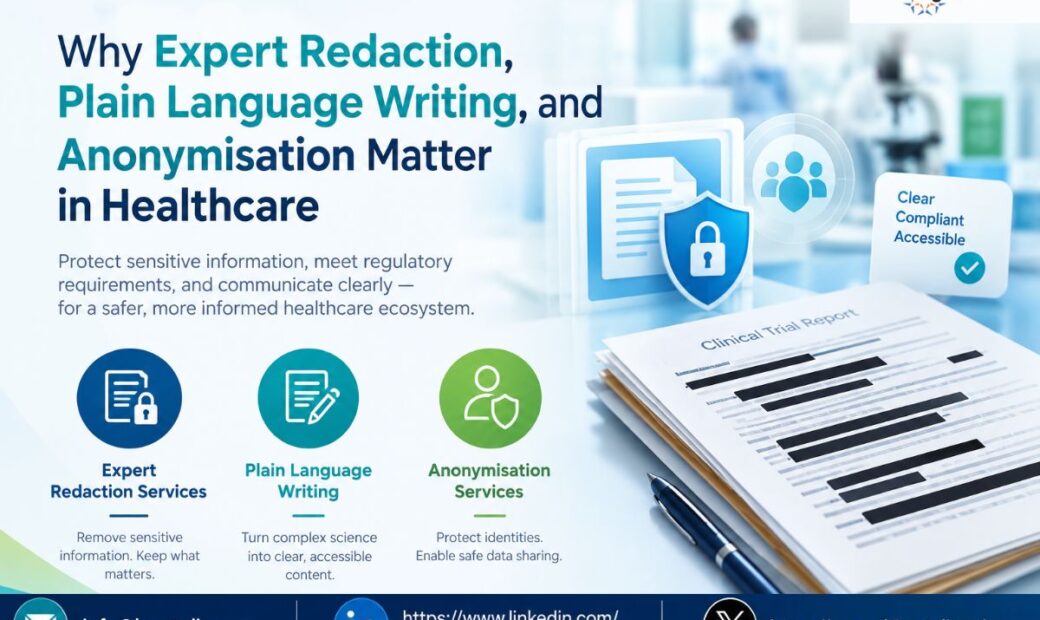
- Expert redaction services can help identify and remove confidential information.
- Anonymisation services can help protect participant and personal information.
- Plain language writing can help make appropriate information clearer and more accessible.
Together, these capabilities can help organisations create documentation that is secure, compliant, accurate, and easier to understand.
Benefits for Healthcare and Life Sciences Organisations
Using specialised services for information management and communication can provide several benefits.
1. Better Data Protection
Professional redaction and anonymisation can help reduce the risk of exposing sensitive personal or confidential information.
2. Improved Regulatory Readiness
Well-managed documentation can support organisations in meeting applicable privacy, transparency, and regulatory expectations.
3. Clearer Communication
Plain language can make complex medical and scientific information easier for intended audiences to understand.
4. Reduced Risk of Errors
Specialist review can help identify sensitive information and communication issues that may otherwise be overlooked.
5. Greater Transparency
Organisations can share appropriate information while taking reasonable steps to protect confidential and identifying details.
6. Improved Accessibility
Clear and well-structured content can help patients, healthcare professionals, researchers, regulators, and other stakeholders find and understand relevant information more effectively.
Choosing the Right Expertise
Healthcare information requires a careful balance between transparency, privacy, accuracy, and accessibility. Organisations should therefore work with professionals who understand both the complexity of medical information and the requirements associated with sensitive data.
A strong service provider should have experience working with healthcare and life sciences content, understand the importance of regulatory compliance, and apply a consistent approach to document review and content development.
The right expertise can help organisations avoid unnecessary information disclosure while ensuring that important content remains useful and accessible.
How Krystelis Can Help
Krystelis supports healthcare and life sciences organisations with specialised services for managing, protecting, and communicating complex information. Its capabilities across expert redaction services, plain language writing, and anonymisation services can help organisations address important requirements related to privacy, transparency, compliance, and communication.
Whether the requirement involves clinical trial documentation, regulatory information, medical communications, public disclosure, or sensitive healthcare content, a structured approach can help ensure that information is handled appropriately.
Conclusion
As healthcare becomes increasingly data-driven, organisations must think carefully about how information is protected, communicated, and shared. Sensitive information needs appropriate safeguards, while useful medical and scientific knowledge should remain clear and accessible.
Expert redaction services, plain language writing, and anonymisation services provide practical ways to address these needs. By combining privacy protection with clear communication, healthcare and life sciences organisations can manage sensitive information more responsibly while supporting transparency and better understanding.
With the right expertise and processes, organisations can protect what needs to remain confidential while ensuring that the right information reaches the right audience in a clear, accurate, and meaningful way.