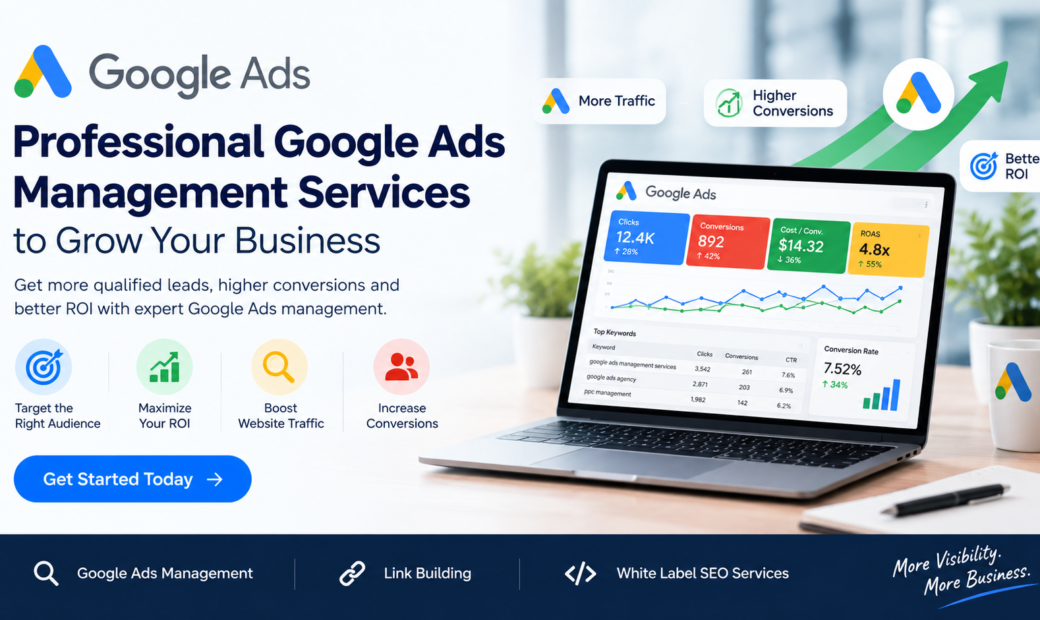
Professional Google Ads Management Services to Grow Your Business

Running Google Ads looks simple until you actually manage a campaign. You choose keywords, write ads, set a budget, and wait for customers. But as I have found through research, this approach often leads to wasted spending because Google Ads rewards relevant targeting, strong landing pages, accurate conversion tracking, and continuous optimization.
This is where professional google ads management services can make a real difference.
The problem becomes bigger when competition increases. Businesses now compete for the same high-intent searches, and every click can cost more. WordStream’s 2026 benchmark study analyzed more than 13,000 search advertising campaigns across 23 industries from April 2025 through March 2026, showing how important current campaign data has become for making PPC decisions.
As per my experience, businesses should not look at Google Ads as simply an expense. They should look at it as a measurable customer acquisition channel.
The Problem: Google Ads Can Burn Your Budget
The biggest problem I see with paid advertising is not that Google Ads does not work. The problem is poor management.
A campaign can spend hundreds or thousands of dollars while attracting people who have no intention of buying. Broad keywords, weak ad copy, poor landing pages, incorrect locations, irrelevant search terms, and weak conversion tracking can all reduce performance.
The business owner may see clicks inside the Google Ads account and assume everything is working. But clicks do not pay the bills. Leads, sales, bookings, calls, and revenue do.
As per my research, the cost of search advertising has also become a serious consideration. WordStream’s 2025 benchmark analysis found that average CPC across Google search ads was $5.26, while the average conversion rate was 7.52%. The same research found that CPC increased across 87% of industries.
This tells me something important: businesses cannot simply launch campaigns and leave them running.
They need a strategy.
The Agitation: More Competition Means Less Room for Mistakes
Imagine a local service company spending $3,000 every month on Google Ads.
The company receives plenty of clicks, but only a small number of leads. The owner starts asking, “Where is my money going?”
This situation can happen when campaign management focuses on traffic instead of business results.
A professional google ads management company looks beyond clicks. It studies search terms, conversion rates, cost per lead, bidding performance, audience behavior, landing pages, device performance, locations, and other campaign signals.
As I found it over research, the difference between a campaign that survives and one that grows often comes down to how regularly the campaign gets reviewed and improved.
Google itself recommends tracking conversions and optimizing campaigns around business goals rather than simply measuring traffic. Google Ads also allows advertisers to control budgets and adjust spending as campaign performance changes.
That matters because no two businesses have the same customer journey.
A $50 product and a $5,000 service should not use the same PPC strategy.
The Solution: Professional Google Ads Management Services
Professional google ads management services help businesses turn paid search into a structured marketing channel.
The process starts with understanding the business.
I believe this step often gets ignored. Before creating campaigns, an experienced PPC manager should understand the target customer, products or services, geographic market, competitors, average customer value, sales cycle, and business goals.
From there, the campaign can focus on the searches that matter.
For example, a company selling emergency plumbing services should not waste most of its budget on general plumbing information searches. It should focus on high-intent searches where users are more likely to need immediate help.
The next step involves campaign structure, keyword research, negative keywords, ad copy, bidding, audience targeting, conversion tracking, and landing page alignment.
The objective is simple: put the right message in front of the right person at the right stage of the buying process.
Why Data Should Drive Your Google Ads Strategy
I always believe that marketing decisions become stronger when data supports them.
Google Ads provides a large amount of performance information. A professional manager can use this information to identify which keywords generate conversions, which advertisements receive quality traffic, which locations perform better, and where the business wastes money.
For example, WordStream’s 2025 benchmark data found an average Google Ads cost per lead of $70.11 across the industries it analyzed. However, costs varied considerably between industries, with some categories reporting much higher or lower averages.
This is why I would not recommend judging a campaign using a generic “good CPC” or “good CPL” number.
A $100 lead may be expensive for one company and highly profitable for another.
If a company earns $2,000 from an average customer, paying $100 for a qualified lead may make sense. If the average customer value is $150, the same lead cost could create a serious problem.
The business model must come first.
A Real Google Ads Case Study Shows the Potential
A useful example comes from Google’s own case study of Talley & Twine, a watch company.
According to Google, the company initially invested $9,000 in Google Ads and generated $40,000 in revenue from that investment. Later, the company invested $120,000 and generated $466,000 in revenue during Q1 2022, which Google reports as a 300% ROI.
I find this case study useful because it shows why businesses should not judge paid advertising only by the initial cost.
Talley & Twine started with a smaller investment, measured the results, and increased its investment after seeing positive performance.
Another Google case study provides an even stronger example. Eberjey reported a 177% increase in revenue from Google Ads in 2018 after increasing its investment, and the company stated that half of its online business came from Google Ads.
These examples do not mean every business will achieve the same results. As per my research, campaign results depend heavily on industry, competition, offer, website experience, budget, targeting, and execution.
But they demonstrate the basic point: well-managed paid search can become a growth channel rather than just another marketing expense.
Google Ads and White Label SEO Services Can Work Together
Paid advertising should not always operate separately from organic marketing.
This is where white label seo services can become useful for agencies that want to provide SEO and PPC under one client strategy.
SEO works toward long-term organic visibility, while Google Ads can help businesses reach customers immediately for valuable searches.
For example, an agency may use SEO to build organic rankings for competitive commercial keywords while using Google Ads to capture immediate demand.
The two channels can also provide useful data for each other.
Search terms that convert well through paid campaigns may reveal opportunities for SEO content. Similarly, organic search data can help businesses understand what customers want before they expand paid campaigns.
Link Building Still Supports the Bigger Search Strategy
Although Link Building does not directly manage a Google Ads campaign, it can support the wider search marketing strategy.
Quality links can help strengthen a website’s authority and support organic SEO efforts. When businesses combine SEO, content, Link Building, and paid search, they can build multiple ways for potential customers to discover the brand.
As per my experience, this creates a more balanced digital marketing approach.
Google Ads can capture immediate demand. SEO can build long-term visibility. Content can answer customer questions. Link Building can support organic authority.
Each channel has a different role.
The PAS Solution: Turn Advertising Problems Into Measurable Growth
The PAS framework starts with the Problem: businesses waste advertising budgets when campaigns lack proper targeting, tracking, and optimization.
Then comes the Agitation: rising competition and advertising costs mean mistakes can become expensive. A campaign that wastes even a small amount every day can create a significant loss over several months.
Finally comes the Solution: professional Google Ads management gives businesses a structured way to research, launch, measure, and optimize campaigns.
As I see it, the goal should never be to spend more money simply because the campaign is performing well. The goal should be to identify profitable opportunities and scale them carefully.
Why Professional Management Makes Sense
Google Ads continues to give businesses access to people who actively search for products and services. Google explains that Search campaigns can help businesses reach people while they are actively searching for what they offer.
But access alone does not guarantee results.
A professional google ads management company can help businesses make better decisions around budget allocation, campaign structure, keyword selection, bidding, ad messaging, conversion tracking, and ongoing optimization.
As per my research and the available case studies, the strongest approach is not to treat Google Ads as a set-and-forget advertising tool.
Treat it as a business system.
Track it.
Test it.
Improve it.
Then scale what works.
For businesses that want measurable customer acquisition, professional google ads management services can provide the structure needed to turn paid search from a source of uncertainty into a controlled growth channel. And when PPC works alongside white label seo services, content, and Link Building, businesses can build both immediate visibility and long-term search presence.