EU Trademark Registration for UK Businesses: Why Your Trademark Stops at the Border

Most UK business owners find out the hard way. A customer forwards a link, or a supplier mentions it in passing, and there is a company in Spain or Poland trading under your name. You dig out your trademark certificate, read it properly for the first time in years, and notice the words you had never needed to notice before. United Kingdom.
That certificate is doing exactly what it was always designed to do. It is just that since 2021 it stops at the Channel, and a lot of businesses selling into Europe have not caught up with what that means.
Your UK trademark does not cover the EU
This is the position today, and it is worth stating plainly because a lot of businesses assume otherwise. A UK trademark protects you in the United Kingdom. It does nothing for you in Ireland, Germany, France or anywhere else in the bloc.
It was not always this way. Until the end of 2020 an EU trademark covered the UK too, because the UK was a member state. When the transition period ended, the UK Intellectual Property Office automatically created a comparable UK right for every EU trademark that was already registered, so nobody lost protection overnight. That was a one-off exercise for marks that already existed.
Everything filed since then is one or the other. So if you registered your brand in the UK in, say, 2022, and you have been shipping to Dublin, Berlin and Amsterdam ever since, you have no registered protection in any of those markets. Not because anything went wrong, but because you bought a UK right and that is what a UK right does.
Newer businesses often find this the most surprising, because for them there was never a version of the world where one registration covered both.
What EU trademark registration gives you
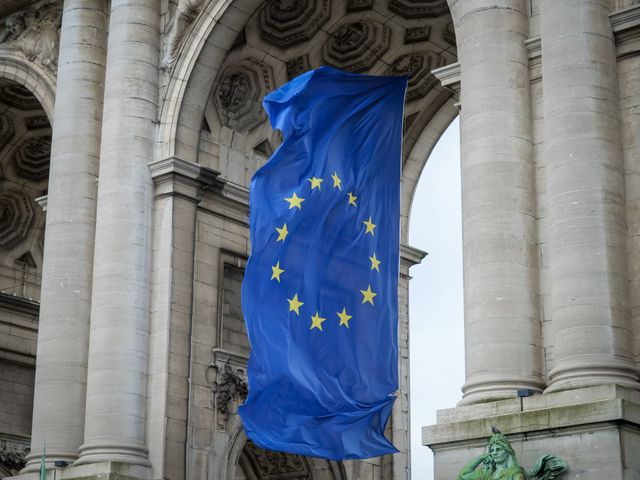
An EU trademark, often shortened to EUTM, is one registration covering all 27 member states. One application, one fee, one examination, and protection that runs from Ireland to Bulgaria.
It lasts ten years from the filing date and can be renewed indefinitely in ten-year blocks. It gives you the right to stop other businesses using an identical or confusingly similar name on similar goods or services anywhere in the bloc, and it gives you standing on the takedown and brand-protection programmes most large marketplaces run.
The alternative is filing country by country, which is slower and considerably more expensive once you are past two or three markets. For most businesses selling across Europe, EU trademark registration is the sensible route rather than the ambitious one.
The part people underestimate: it is all or nothing
This is the single most important thing to understand before you file, and it is the bit that catches people out.
An EU trademark is examined as one mark across the whole bloc. That means an earlier conflicting right in a single member state can block the entire application. A business in Portugal you have never heard of, trading under something close to your name, can stop you registering across all 27 states.
That is not an argument against applying. It is an argument for searching properly first. A clearance search across the EU register before you file costs a fraction of a failed application, and it tells you whether you are walking into a problem while you still have options.
There is a safety net worth knowing about. If an EU application is refused or successfully opposed, it can usually be converted into national applications in the member states where there was no conflict, and those keep the original filing date. It is more expensive and more administrative than getting it right first time, but it means a blocked application does not necessarily mean starting from scratch.
Do you actually need one?
Not every UK business does, and it is worth being honest about which situation you are in.
If you trade in the UK only, with no European customers and no plans to have any, your UK registration is enough. Adding EU cover would be buying protection in markets you do not serve.
If you sell, ship or market into any EU member state, you almost certainly need both. This is the common position for growing brands, and it is close to universal for anyone selling through European marketplaces.
The grey area is the third group: businesses with EU customers but no physical presence in Europe. If people in Ireland or Germany can find you and buy from you, your brand has value there, and someone can register it before you do. Whether that justifies the cost depends on how much of your revenue those customers represent and how likely you are to grow into that market. It is a commercial judgement, not a legal one.
What EU trademark registration costs
The EUIPO’s official fees are published and straightforward. At the time of writing an online application costs 850 euros for the first class of goods or services, 50 euros for a second class, and 150 euros for the third and each further class.
Classes are the categories the register is divided into. Picking them properly matters more than picking a lot of them. A business that sells a physical product and also offers a service will usually need at least two, and paying for a third class you do not need is money spent protecting nothing.
Currency moves and official fees change from time to time, so treat those figures as a guide and confirm the current position before you budget. Professional fees sit on top, and vary depending on whether you want someone to run the search, draft the specification and handle the EUIPO correspondence, or just file it.
One thing to be aware of if you go looking for ways to reduce the bill. The EUIPO runs an SME Fund that reimburses a substantial share of trademark application fees, and you will see it advertised widely. It is open to small and medium-sized businesses established in the European Union, which since 2021 no longer includes UK businesses. It is worth knowing about so you do not budget around a discount you cannot claim.
How long it takes
In a straightforward case with no objections, expect somewhere around four to six months from filing to registration.
The application is examined, then published for a three-month period during which third parties can oppose it. If nobody does, it proceeds to registration. If somebody does, the timeline extends considerably and the outcome depends on the strength of their earlier right and yours.
That three-month window cuts both ways. It is also how you find out that somebody else is trying to register something close to your mark, which is an argument for keeping an eye on the register once you are established in Europe.
One obligation that arrives later
An EU trademark is not something you register and forget. After five years it becomes vulnerable to cancellation if it has not been genuinely used in the EU for the goods and services it covers.
Genuine use means real commercial activity, not a token sale to keep the registration alive. It does not have to be in every member state, but it does have to be real.
In practice this matters most for businesses that register defensively across a broad specification and then only trade in one narrow area. If a competitor later wants your mark, the unused parts of your registration are the first thing they will attack. Registering for what you actually do, and keeping evidence of doing it, is the whole defence.
What to do before you file
- Check what your existing registration actually covers. Read the certificate rather than relying on memory, and note the territory and the classes.
- Write down where you sell now and where you realistically expect to sell in the next three years. That list decides whether EU cover is worth it.
- Search the EU register for identical and similar marks, not just identical ones. A name does not have to match exactly to block you.
- Get the classes right before filing rather than after. Adding cover later means a new application and a later filing date.
- Decide who is handling the EUIPO correspondence. If an objection or opposition arrives, somebody needs to deal with it inside the deadline.
- Remember what an EU trademark does not cover. The UK needs its own registration, and non-EU European countries such as Switzerland, Norway and Turkey each need their own filing.
The honest summary
If you sell into Europe and your only registration is a UK one, there is a gap between what you think you own and what you actually own. It has been there since January 2021 and it will not close on its own.
That does not mean panic. It means finding out where you stand, deciding whether the European market matters enough to protect, and if it does, searching properly before you file rather than after. The businesses that run into trouble are almost never the ones that thought about it and decided no. They are the ones that never checked.
If you want a straight answer on whether you need EU cover and what it would cost, The Trademark Helpline offers a free initial review and will tell you if you do not need to apply. You can read more about EU trademark registration