Introduction
Pricing used to be simple almost comforting. A number was chosen, published, and left alone until someone noticed sales dipping or a competitor getting noisy. Those days are long gone. Today, prices change quietly and constantly, sometimes multiple times a day, often without any obvious signal to the outside world. A product that cost one amount in the morning may be cheaperor oddly more expensive by dinner. Most customers notice. Most businesses feel the pressure. Very few talk openly about how they keep up.
Here’s the uncomfortable truth: modern markets move too fast for gut instinct and spreadsheets alone. Competitors adjust pricing in real time. Marketplaces experiment relentlessly. Discounts appear, disappear, and reappear under different names. And somewhere in the background, data is doing the heavy lifting lots of it.
That’s where web scraping enters the conversation. Not as a flashy growth hack or a secret weapon, but as a practical, behind-the-scenes system for understanding what’s actually happening in the market right now not last quarter, not last month. Used well, it turns chaos into context. Used poorly—or not at all it leaves companies reacting instead of leading.
This post breaks down how web scraping supports pricing intelligence and market monitoring, why it matters more than ever, and where its real value quietly shows up.
Why Pricing Is No Longer a Set-It-and-Forget-It Game
There was a time when pricing felt stable, even predictable. A product launched, a price was set, and barring a seasonal sale or a dramatic cost increase, that number stayed put. Customers adapted. Competitors followed suit. Everyone more or less understood the rules of the game.
That stability has quietly evaporated.
Today’s pricing environment is fluid by design. Online marketplaces encourage constant experimentation. Algorithms test small adjustments and watch what happens. Promotions are personalized, time-boxed, and sometimes invisible to anyone except a narrow slice of shoppers. What looks like inconsistency from the outside is often deliberate strategy on the inside.
Here’s where it gets interesting: customers have adapted faster than most businesses expected. Comparison shopping is second nature now. A single tab open turns into five. A “fair price” isn’t defined by brand loyalty anymore, but by what’s visible at that exact moment. And visibility cuts both ways.
For businesses, this creates a subtle but relentless problem. Pricing decisions are no longer isolated choices made in quarterly meetings. They’re reactions—to competitors, to demand shifts, to inventory levels, to promotions that appear without warning. Miss those signals, and pricing drifts out of sync. Overreact to them, and margins quietly erode.
That tension between moving too slowly and moving too fast—is the real pricing challenge today. And it’s the reason pricing intelligence stopped being optional and started becoming infrastructure.
Let’s pause for a second and look at what actually powers that intelligence—because it’s not guesswork, and it’s definitely not manual checking.
Web Scraping, Explained Like a Human Would Explain It
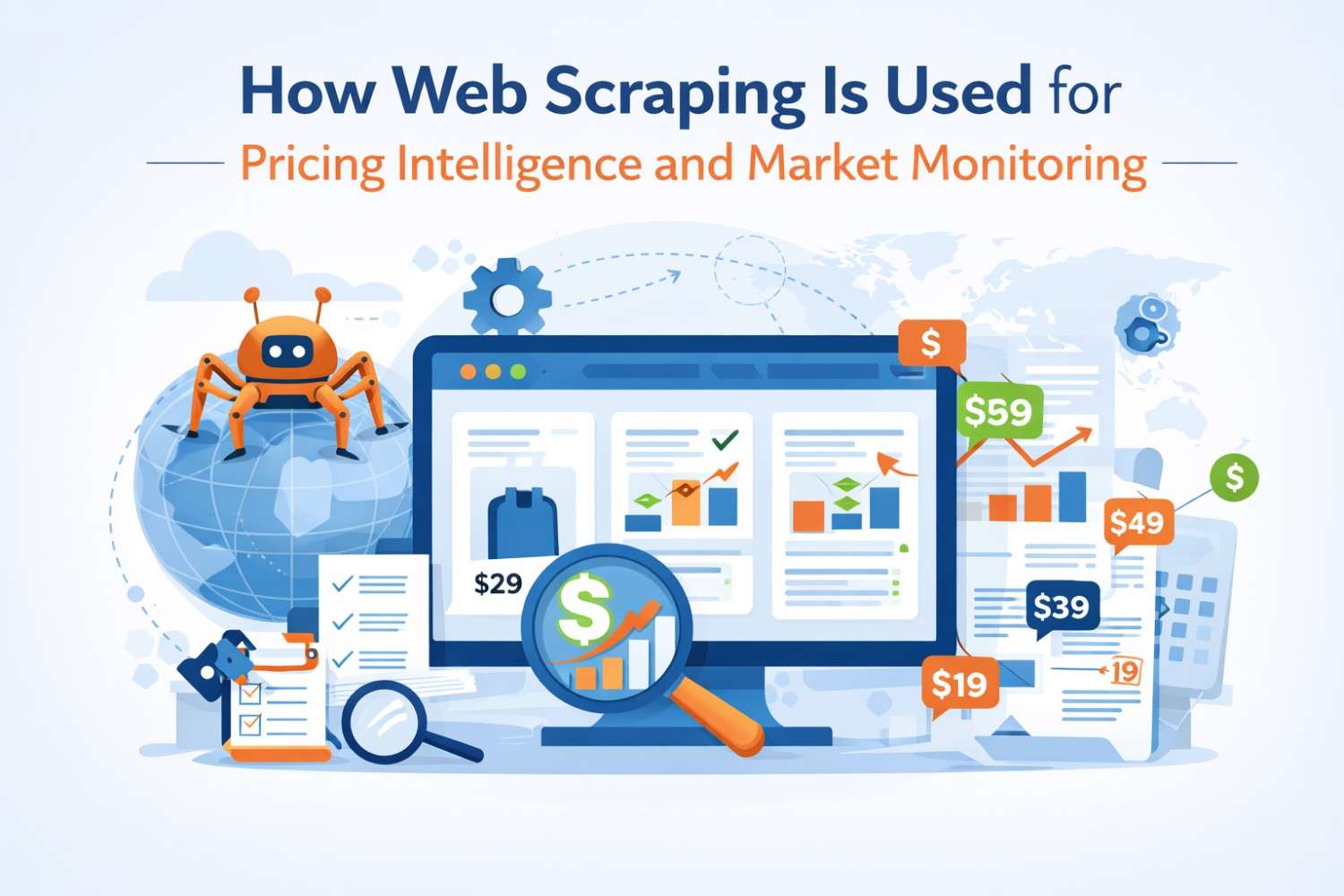
Web scraping sounds more technical than it needs to be, which is probably why it gets misunderstood so often. Strip away the jargon, and it’s simply a structured way of collecting publicly available information from websites at scale. Prices, product names, availability, discounts—anything a customer can see manually can also be gathered systematically.
The difference, of course, is speed and consistency. Manually checking a competitor’s site once a week might catch a big sale. Doing it across hundreds of products, multiple regions, and several competitors—every day or even every hour—is where human effort breaks down. That’s the gap web scraping fills quietly and efficiently.
What makes this approach powerful isn’t just volume. It’s context. Raw prices alone don’t mean much without knowing when they change, how often they fluctuate, or what else changes alongside them. A sudden discount paired with limited stock tells a very different story than a discount paired with a homepage banner and free shipping. Over time, these patterns stop looking random and start revealing strategy.
There’s also an important boundary worth noting. Ethical web scraping focuses on publicly accessible data and respects site rules and legal frameworks. It’s not about “stealing” information or gaining unfair access. It’s about observing the market the same way customers do—just with better memory and far less caffeine.
And once that data is collected consistently, something interesting happens. Pricing decisions stop being reactive guesses and start becoming informed responses. That’s where pricing intelligence begins to take shape.
How Businesses Turn Raw Data Into Pricing Intelligence
Collecting data is the easy part. The real value shows up when that information is cleaned, compared, and interpreted over time. Pricing intelligence isn’t about knowing today’s lowest price—it’s about understanding why that price exists and what it’s likely to do next.
At its core, pricing intelligence connects competitor pricing, historical trends, and market signals into a single picture. A product that drops in price every Friday tells a different story than one that fluctuates randomly. A competitor that consistently undercuts new launches but raises prices once reviews stabilize is following a pattern, not improvising.
This is where Price Monitoring becomes more than a dashboard metric. When tracked consistently, it highlights behaviors rather than just numbers. Promotions start to look predictable. Aggressive pricing reveals where competitors are willing to sacrifice margin—and where they’re not. Over time, that insight informs smarter pricing moves without constant firefighting.
There’s also a psychological shift that happens here. Decisions stop being driven by panic (“They dropped prices again”) and start being driven by perspective (“This always happens before a product refresh”). That difference is subtle, but it’s often what separates profitable pricing strategies from reactive ones.
Once pricing intelligence is in place, attention naturally expands beyond price alone. Because markets, as it turns out, signal far more than just cost.
Market Monitoring Is Bigger Than Numbers on a Screen
Price is only one piece of the market puzzle. Focusing on it alone is a bit like judging traffic by looking at a single car. Useful, occasionally—but rarely enough.
Market monitoring widens the lens. Product availability offers clues about demand and supply pressure. Frequent stockouts suggest strong sales or fragile logistics. Sudden restocks paired with discounts may hint at overestimation. New product listings often appear quietly before major launches, acting as early signals for where the market is headed next.
Promotions matter too, especially how they’re framed. A price drop labeled as a “limited-time offer” sends a different message than one quietly baked into a product page. Over time, these signals reveal how competitors position value, not just how they price it.
Taken together, market monitoring turns scattered observations into a narrative. Not a perfect one—but a far clearer picture than isolated snapshots ever could. And once that narrative is visible, the question becomes less about whether to act and more about how to act intelligently.
That’s usually the point where companies realize this isn’t something they want to manage alone.
Why Most Companies Don’t Build This Themselves
At first glance, building an internal scraping system seems reasonable. After all, the logic sounds straightforward: collect data, store it, analyze it. In practice, though, this is where enthusiasm tends to collide with reality—hard.
Websites change constantly. Page layouts shift. Class names disappear. Anti-bot measures evolve. What worked reliably last month can quietly fail this week, leaving teams with gaps in data they don’t notice until decisions start feeling… off. Maintaining scrapers becomes less about strategy and more about firefighting.
This is why many organizations eventually turn to Web Scraping Services. Not because they lack technical talent, but because the operational overhead adds up fast. Managing proxies, ensuring data accuracy, handling errors, and normalizing information across dozens of sources is a full-time responsibility, not a side project.
There’s also a less obvious benefit: consistency. External services are designed to collect data the same way, every time, across markets and regions. That reliability is what makes long-term trend analysis possible. Without it, even the best dashboards end up telling half-stories.
And once that foundation is stable, the applications start multiplying.
How Different Industries Actually Use This Data
Pricing intelligence and market monitoring aren’t confined to one vertical. Their value shows up wherever competition is visible and customer choice is abundant—which, these days, is almost everywhere.
In e-commerce, scraped data helps retailers spot aggressive discounting early, identify products turning into price wars, and protect margins without drifting out of market range. In travel and hospitality, constant monitoring reveals demand spikes, seasonal behavior, and the subtle timing of competitor promotions.
SaaS companies use market data differently. Instead of tracking SKUs, they watch plan structures, feature bundling, and trial offers. A competitor quietly removing a free tier or changing onboarding flow can be just as meaningful as a price increase.
Even B2B marketplaces benefit. Pricing transparency may be lower, but product availability, catalog expansion, and positioning shifts still leave digital traces. Those traces, collected over time, offer strategic insight that’s difficult to get any other way.
Across industries, the pattern is the same: better visibility leads to calmer decisions. And calmer decisions tend to age better.
The Part Everyone Skips (But Shouldn’t)
It’s tempting to treat market data as a source of certainty. Numbers feel authoritative. Charts look convincing. But data without interpretation is just noise with good branding.
One common mistake is overreacting to competitors. A single price drop doesn’t always demand a response. Sometimes it’s a clearance move. Sometimes it’s a test. Sometimes it’s a mistake that gets corrected quietly hours later. Context matters—and context only emerges over time.
There’s also the legal and ethical side. Responsible market monitoring respects public data boundaries and site policies. Sustainable strategies are built on observation, not exploitation. Cutting corners here tends to backfire, usually at the worst possible moment.
In other words, intelligence isn’t about knowing everything. It’s about knowing enough to act deliberately.
Best Practices for Sustainable Pricing Intelligence
The strongest pricing strategies share a few traits. First, they start with clear goals. Tracking everything “just in case” sounds thorough, but it rarely produces clarity. Focused questions lead to useful data.
Second, trends matter more than moments. Daily fluctuations are interesting; weekly and monthly patterns are actionable. Zooming out often reveals stability where chaos seemed obvious up close.
Third, pricing data works best when paired with human judgment. Algorithms surface signals, but people decide what they mean. The healthiest setups treat data as an advisor, not an authority.
When these practices are in place, pricing intelligence stops feeling like a defensive tactic and starts functioning as quiet leverage.
The Quiet Advantage Most Companies Overlook
Pricing intelligence rarely announces itself. There’s no dramatic reveal, no single “aha” moment. Its value accumulates slowly, almost invisibly, through better timing, fewer mistakes, and decisions that age well.
Markets will always move. Competitors will always experiment. The difference lies in whether those movements feel surprising or expected. Organizations that invest in understanding patterns—rather than reacting to snapshots—tend to operate with more confidence and less urgency.
And in a landscape defined by constant change, that steadiness might be the most underrated competitive edge of all.
Conclusion
Markets rarely announce what they’re about to do. Prices shift quietly, promotions come and go, and competitors experiment behind the scenes. From the outside, it can feel like everything is moving at once, just slightly out of sync. That’s usually when pricing decisions get rushed—and when small missteps start adding up.
What pricing intelligence and market monitoring really offer isn’t control. It’s clarity. A way to replace assumptions with patterns, and reactions with context. When market behavior is observed consistently, surprises become signals and noise starts to fade into the background. Decisions slow down, even when the market doesn’t.
There’s a subtle confidence that comes from knowing why a price changed, not just that it did. Over time, that confidence compounds. Pricing becomes less about keeping up and more about choosing when—and when not—to move.
In the end, the advantage isn’t having more data than everyone else. It’s understanding the market well enough to stop chasing it.
Frequently Asked Questions
What types of data are most useful for pricing intelligence?
Competitor prices, historical price changes, promotions, stock availability, and product positioning tend to provide the most actionable insight when analyzed together.
How often should pricing data be updated?
That depends on the market. Highly competitive online sectors may require daily or near-real-time updates, while slower-moving industries benefit from weekly or monthly monitoring.
Is web scraping legal for price tracking?
Collecting publicly available data is generally permissible when done responsibly and in line with website terms and applicable regulations. Legal guidance is always recommended for large-scale initiatives.
Can small businesses benefit from market monitoring?
Yes. Even limited monitoring can reveal competitor behavior, pricing gaps, and opportunities that would otherwise go unnoticed.
How does pricing intelligence affect long-term strategy?
Over time, it shifts decision-making from reactive adjustments to informed planning, helping businesses anticipate changes instead of chasing them.